Open Payment System
Introducing Standard Service Packages (SSPs)
We're eliminating the ~$496 billion administrative tax on American healthcare. Today's claim groupers are proprietary and rely on outdated logic, contributing to widespread industry fragmentation as providers and payers implement bespoke processes to support them. They offer no clear delineation between simple services, encounters and episodes, making it nearly impossible to know when and how to tie facility and ancillary fees. For providers and payers, this complexity drives administratively costly claims denials and appeals processes. For patients, it means almost never being able to predict what you'll pay for your care.
Our solution: an open-license, transparent, grouping methodology. Standard Service Packages (SSPs) consolidate all medical services, materials, and fees associated with a healthcare procedure into a single code. They are open-source, patient-first, and compatible with current transaction standards including the various UB-04 bill types and CMS-1500.
For providers & payers: SSPs collapse the revenue cycle to a single encounter-level price, reducing administrative overhead and enabling prospective contracting in place of retroactive reconciliation.
For patients: SSPs enable accurate upfront cost guarantees for both cash- and insurance-pay services and point-of-service payment, eliminating surprise bills and delayed reconciliation.
What is a Standard Service Package?
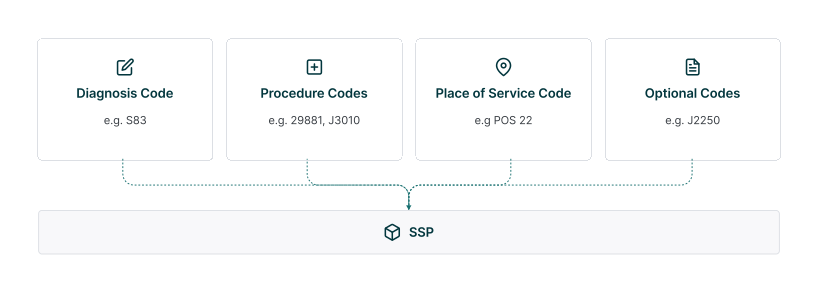
SSPs are a bundle of codes that represent what actually gets billed alongside a primary procedure code. All services, materials, and fees associated with a healthcare procedure are consolidated into a single package including revenue codes, professional fees and ancillary services such as labs and drugs.
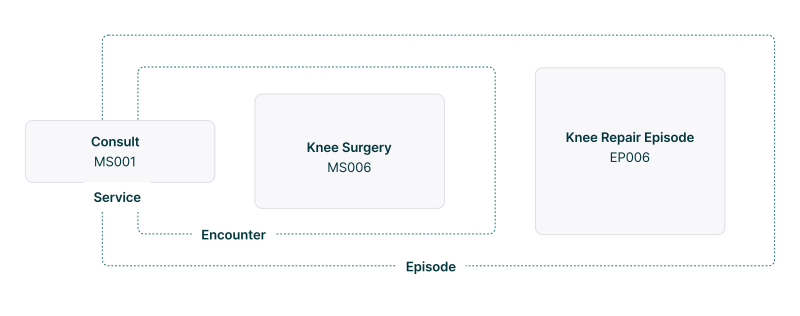
SSPs can be structured at three different levels of care: individual procedures or discrete clinical services (‘items & services’), single visit procedures (‘encounters’) or multi-visit care journeys for a specific condition (‘episode’).
SSPs adhere to the following heuristic:
- Clinical Similarity & Relevance: A clinician would consider all codes within an SSP a reasonable alternative for the same indication; where meaningful complexity differences exist, these are captured as clinical variants (‘sub-groupers’) rather than separate SSPs.
- Cost comparability:Medicare and commercial rates inform clinical variants, with Medicare carrying stronger weight given its structural tie to clinical inputs (rather than the noise seen in negotiated commercial rates)
- Consumer Comprehension & Relevance: Most importantly, SSPs must be consumer-first meaning they intuitively reflect the way a patient can expect to find, receive and ultimately pay for care.
Why isn’t price the primary driver of our grouping methodology?
Price-led grouping would produce an unmanageably large number of groupers and undermine the clinical coherence that makes the SSP useful for both physicians and consumers. Instead, we use reimbursement rates as a validation signal. When a description-driven complexity split is corroborated by a meaningful Medicare rate step, that convergence confirms the variant is clinically relevant. Clinical variants at the sub-grouper level preserve shopping simplicity for consumers, while giving providers the flexibility to apply stricter reimbursement parameters at the variant level if they choose.
What is included in a SSP?
- A unique, five digit alphanumeric code, compatible with current claim field requirements.
- A consumer-facing name describing the procedure . This includes grouper description and descriptions for each clinical variant.
- Shoppability index which reflects the degree to which a patient can shop for a service.
- Service categorization covering service type, place-of-service, and disease area.
- Aggregate view of ancillary services, codes & fees that are billed in association with a procedure.
How do we define 'Shoppability'?
Our Shoppability Index uses claims data to categorize every service into five unique archetypes that reflect how patient behavior and decision-making vary across care types, ranging from emergent, low-shoppability services to high-shoppability commodity diagnostics. The relative shoppability of a service is determined by key inputs including provider preference strength, price elasticity, and outcome predictability.
We have released a small subset of our SSP library, with more being published on a rolling basis. The sampling below focuses predominantly on shoppable services and procedures. Explore the table to see how they work.
SSP Name | Disease Area | Shoppability | Place of Service | |
|---|---|---|---|---|
Fee schedule
SSPs are designed to enable consumer-facing estimates using various reimbursement models.
For contracting, we support two primary price-setting approaches:
- Medicare: Every SSP is mapped to a Medicare APC rate (or DRG), allowing group purchasers and providers to easily set reimbursement terms as a percentage of Medicare
- Fee-schedule: SSPs can also be priced using a relative-weight fee schedule. These weighted averages, derived from our Clear Rates benchmark rates, allow a single conversion, or 'base rate,'' be applied across all SSPs giving purchasers and providers a simple, scalable approach to set and adjust reimbursement across a full catalog of services
Implementation guide
Grouper
The SSP Claims Grouper is an open license grouper that developers may use to group claims and pre-claim estimates to a Standard Service Package.